
Stepping to the Other Side of the Mic:
My First Time Being Interviewed
October 2013
For years, I’ve been the one holding the microphone, asking the questions, and chasing the story. As a journalism student, I’ve spent countless hours interviewing others, always comfortable behind the scenes. But recently, the roles were reversed—I had my very first experience being the interviewee.
It was a surreal and eye-opening moment to finally be the one sharing my own story rather than documenting someone else's. I want to say a huge thank you to Michelle Schaner for the wonderful article and for making my first time on the "other side" such a positive experience.
Behind the Byline
Published on Oct 28, 2013 at Myanmar Times Newspaper
Contributed by MICHELLE SCHANER
https://www.linkedin.com/in/michelleschaner/
MA Myat Noe Oo will do something this November that would have been unthinkable in Myanmar until recently: She will graduate with a bachelor's degree in journalism.
“I want to be a good journalist. I want to be a famous journalist – not only in Myanmar, but all over the world,” the 19-year-old said. She’s now on her way, thanks to a full-time paid internship at The Myanmar Times. The internship follows an intensive training course conducted by editors from The Myanmar Times and funded by the United Nations Educational, Scientific, and Cultural Organization (UNESCO). In just a few weeks, she has had several articles published in the newspaper.
Ma Myat Noe Oo, along with two other aspiring journalists – Ma Tin Yadanar Htun and Ko Zaw Myo Thein – recently completed the free training program, which was designed to teach the basics of news writing, ethics and reporting.
It was the third and final course under the project, which was funded through UNESCO’s International Programme for the Development of Communication. Some training graduates have continued on at The Myanmar Times beyond their internships, taking full-time jobs as reporters. Others decided journalism was not their chosen career. All interviewed for this article, however, said that they gained more from the experience than they initially realised.
Ko Myo Wyn Nyunt completed his training in April. He said he took the course because he was curious about journalists and what they do. Previously, he did not know how news reports came together and this made him distrustful of the media. However, the training helped him realise that journalists need to follow certain rules and principles when reporting.
Ko Myo Wyn Nyunt is now a freelance writer and is preparing himself for further studies. He dreams of being a political reporter or starting a political blog in the future, and said the skills he gained will be invaluable for his career.
“The knowledge and experience that I got from the training helped me a lot in my work, such as finding reliable information sources and writing clearly and simply,” he said.
For Ma Myat Noe Oo, the training filled in the gaps between what she learned in her degree program and the reality of how news happens at a large privately-owned newspaper. She undertook her bachelor's degree at Yangon University’s National Management College, which has offered journalism courses since 2007.
During her degree, she interned at state media outlets, including the New Light of Myanmar, The Mirror, and MRTV. She also had a brief internship at Myanmar International, a joint venture between the Ministry of Information and Shwe Than Lwin. Although she learned a great deal both inside and outside the classroom,
Ma Myat Noe Oo said she still felt she lacked “news sense”: how to find news. She said at the state-run media that she spent most of her time in the office and did not go out to do interviews. After finishing her degree, she took a job at a small weekly newspaper as a general news reporter. That position, she said, opened her eyes to the difference between learning in school and learning on the job.
“We always had to go out and try to contact people,” she said. “I was very stressed because I did not know how to do it … It was difficult because it was hard to make contact with others because I didn’t know the people.”
The journal where Ma Myat Noe Oo worked had a limited number of staff, which meant the editor could not train the reporters. She said she did not know if she was doing her job correctly but just did what she was told from day to day.
“I would write one or two-source [stories] and sometimes my editor would ask me to just rewrite a press release,” she said.
Her training at The Myanmar Times taught her a reporter should try to find three sources – and sometimes more, depending on the article.
“I told my editor I couldn’t write those stories anymore,” she said. “I told him I needed more sources.”
Ma Tin Yadanar Htun, another trainee in the UNESCO-sponsored program, will also be graduating from the National Management College in November. She said she prefers to pursue a career in print rather than broadcast media because print media is “more free” and will allow her to write and report on topics that most interest her.
“In college we did not write the news ourselves,” said Ma Tin Yadanar Htun. “We learned a lot about the writing style, but we didn’t really write it.”
Ma Tin Yadanar Htun also worked for a small weekly paper after graduation, and said she soon came to understand that the journalist’s job is “not easy”.
The hard part, she said, was coming up with story ideas every week – and sometimes every day. “It is difficult to come up with an idea,” Ma Tin Yadanar Tun said. “One day you have to write one story and the next another. Every day is something new.
“Before I always wrote the press release. But then I learned that I needed to make phone calls, ask more questions.”
The training they underwent at The Myanmar Times was conducted by a mix of Myanmar- and English-speaking editors, who taught recruits the basics of news writing and how to conduct themselves during interviews and in press conferences.
The course also covered topics such as media ethics and libel. Ramon Tuazon, a communications and information specialist at UNESCO’s office in Yangon, said that despite the presence of a formal journalism school, such training programs are still important in Myanmar.
While the freedoms gained in the past year have created a new demand for more specific, advanced journalism training, he said, “demand for more competent entry-level journalists is more pronounced”. Mr Tuazon said “a wide gap” remains between what is needed and what is offered.
The solution, he said, is for the private sector and the university to work together to ensure the industry’s needs are met.
Ma Su Phyo Win completed the training program in April and started an internship at The Myanmar Times immediately afterward. She now works at the paper as a business reporter. Before the training, Ma Su Phyo Win said, she “had no background [in journalism] and I didn’t know what news writing was”.
The training gave her confidence but she said she still was not prepared for the pressure that came from working at a large paper, where she was expected to write several stories a week in both Myanmar and English.
“The first day I felt the pressure – what if I didn’t write enough news articles. I thought I would be fired,” she said. “Now I can do bigger stories. I don’t have much experience, but I can do a big news article. If I have a lot of sources who can tell me what has happened…
I can write very good stories. “At first, I was not interested, and I didn’t know what journalism meant, but later I got addicted to journalism.”
After four months on the job, she’s now certain that she wants to be a journalist. While she is also more aware than ever that she still has a lot to learn, day by day and story by story, she’s gaining knowledge and experience.
“When I see my news article, ‘by Su Phyu Win’, [I feel] a kind of happiness.”
‘When I see my news article ... [I feel] a kind of happiness.’ Ma Su Phyo Win, Reporter, The Myanmar Times
A journalism training program supported by UNESCO helps to train a new generation of reporters for Myanmar’s media industry
‘Before, I always wrote the press release. But then I learned that I needed to make phone calls, ask more questions.’ Ma Tin Yadanar Htun, BA (Journalism) graduate and UNESCO trainee.
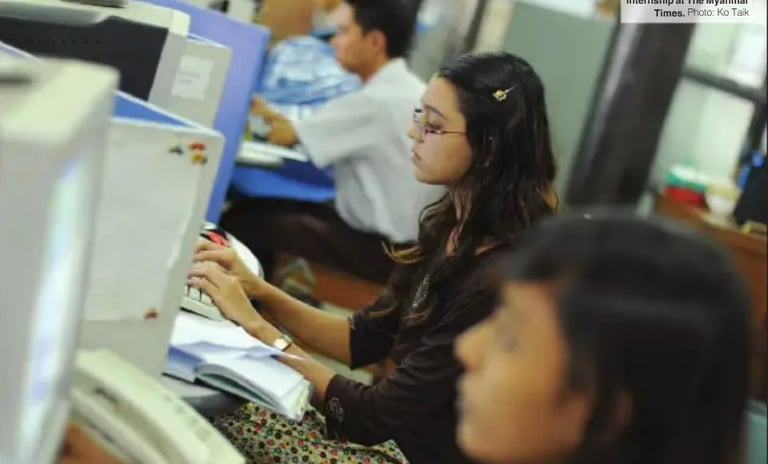
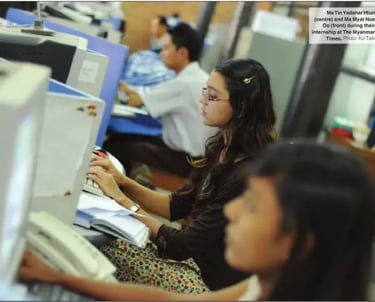
Ma Tin Yadanar Htun (centre) and Ma Myat Noe Oo (front) during their internship at The Myanmar Times. Photo: Ko Taik FEATURE