
Yangon real estate surges in 2013
Published on December 30, 2013 at Myanmar Times Newspaper
Written by Tin (Rubynar) Yadanar Tun
Prices are across nearly all market segments and look set to remain high throughout next year and beyond.
THE Yangon property market enjoyed a boom year in 2013 as Myanmar’s economic opening continued to attract foreign interest and buoyed consumer confidence.
Supply for international-standard offices and housing struggled to meet the increased demand, prices soared across virtually all market segments, from condominiums to industrial land and plots in urban fringe areas.
“On average property prices rose around 50 percent across Yangon. The market was good in every township,” said U Khin Maung Aye from Shwe Kan Myay real estate agency.
But it was the high price of office space that arguably attracted the most attention.
By the end of the year the rent for a Yangon office was around eight times higher than just three years before, said Ko Min Min Soe from Mya Pan Tha Khin real estate agency.
Real estate firm Colliers International estimates the average rental rate for an office is nearly US$80 a square metre – higher than neighbouring Bangkok, Hanoi and even glitzy Singapore.
Apartments were not overlooked as the market soared, with prices in all six downtown townships rising sharply through 2013.
The price of high-end apartments rose about 30pc over 2013, according to U Yan Aung, a real estate analyst.
Further growth is anticipated in 2014 as the Condominium Law, submitted to parliament in November 2012 but still not approved, is likely to allow full foreign ownership of eligible condominium apartments – a change from the blanket ban on foreign ownership under current laws.
Foreigners will be eligible to own apartments on the sixth floor or above of a condominium, with up to 40pc of dwellings in a single building eligible for foreign ownership, according to a draft of the law.
While property owners saw the value of their assets spike this year, this growth caused headaches for the government, which is concerned that high prices are deterring investment, particularly in job-creating enterprises.
In October, the government tried to cool property prices by assessing the price of land and using these values to determine the taxes payable when land ownership changes. Essentially a move to thwart those trying to skirt the 37pc land tax – for those who can’t show proof of income – by simply declaring a lower sales price, the new system has impacted most the high end of the market, with sales of properties in the K1 billion-plus range (US$1.02 million) slowing.
One of the hottest areas this year was previously overlooked outskirt townships known as Dagon Myothit (not to be confused with Dagon township, just north of downtown). Divided into four sections – north, south, east and Dagon Seikkan – the township has attracted both developers and in-dividual buyers looking to avoid the high prices elsewhere.
Developers broke ground on a number of sites in the area this year and three new residential mega-complexes are slated for development in Dagon Seikkan alone.
U Yan Aung, general manager of Sie Khon Naung agency said he expected prices to climb in the four Dagon Myothit townships in 2014.
Further afield in Yangon, progress on the Japanese-backed Thilawa Special Economic Zone (SEZ) in Thanlyin township drove land prices in the area 10 times higher, agents said. While most of the city saw a steady increase in prices, there were similar boom stories in some previously quiet areas.
Across the river from downtown, buyers in Dala township learned first-hand volatile and unpredictable nature of land speculation. In September, rumours of a bridge being constructed across the Yangon River sent prices soaring – some up to 1000 times higher than earlier in the year.
But as it became clearer that the bridge would not become a reality prices quickly plummeted, said real estate expert U Khin Maung Aye.
“Many people wanted to buy in Dala because they thought the bridge project was going to be implemented. Later, they learned that this bridge would not be built, so the price dropped by half,” he said.
Heading into 2014, experts in Yangon said that they expected prices to remain high for the next 12-18 months.
A slowdown is likely after that, how-ever, as government initiatives to ensure residents are not priced out of the market – from improved tax collection to low-cost housing developments – have an impact.
“The property market is also likely to grow strongly in 2014,” real estate analyst U Khin Maung Aye said. “But expect prices to drop when the government implements new low-cost housing projects in Yangon.”
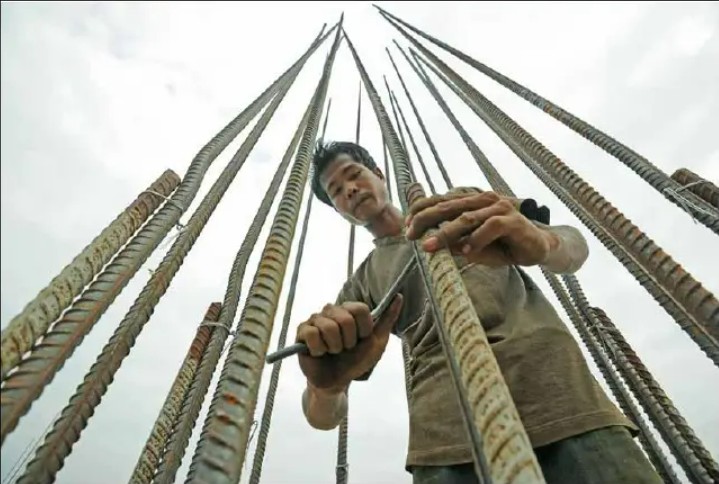
A construction worker inserts rebar on a construction site in Yangon