
Shwedagon and Yangon cannot be divided
Published on 18 May, 2015 at Myanmar Times Newspaper Written by Tin (Rubynar) Yadanar Tun
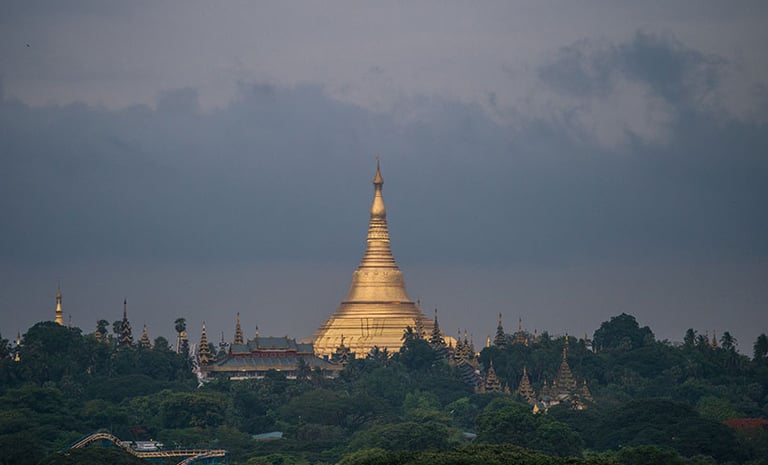
SHWEDAGON Pagoda is the historical and cultural centre of Yangon, and if its character should fade, the character of Yangon will also fade away, said Daw Hlaing Maw Oo, assistant director of the Department of Human Settlement and Housing Development’s Urban and Regional Planning Division.
If modern high-rise buildings are built close to the pagoda, their lights could diminish its character, she said at the Save Shwedagon Forum, hosted by the Association of Myanmar Architects at the DHSHD meeting hall in Yangon on May 17.
“We are worried that we won’t be able to see Shwedagon from nowhere [sic] in Yangon, so from now on there will be regulations,” said Daw Hlaing Maw Oo. “We need a city development law to protect this historical site, and also to protect downtown Yangon.”
She said the proposed rules would prevent high-rise buildings from being built very close to the pagoda.
Though the government is yet to accept any of the suggestions made at the forum or by the association, Daw Hlaing Maw Oo said the Association of Myanmar Architects has sent an advisory letter to the president, state government members and related ministries and organisations, requesting them to help save Shwedagon and its surroundings, said U San Oo, chair of the association.
“We sent letters asking them to carry out technical research on the local ecosystem, the level of ground water, construction heights, volume and capacity, as well as the viewpoints from which it is possible to see the pagoda, before any new projects are built,” he said.
“We are trying to save Shwedagon and will protest against anyone who fails to consider Shwedagon’s viewpoints and its environment,” said U San Oo.
In February, large construction projects were suspended in the northern proximity to the site.
The most prominent is one of three giant projects led by business magnate, Dagon Township MP and former industry minister U Aung Thaung, called “The Landmark”, which is to be located near the intersection of U Htaung Bo Road and Shwedagon Pagoda Road.
Another 23-storey building has been planned at the corner of U Htaung Bo and Dhammazedi roads in Bahan township, on a block of land between the old Tarmwe and U Htaung Bo roads.
Other projects were suspended during this year’s Union Day holidays when social networks and news journals began focussing growing public concerns about the environmental and religious impact of the construction. In response to this outpouring of public sentiment, President U Thein Sein ordered officials to investigate the issue and implement “special protection” for the area.
Yesterday, a spokesperson for the president declined to comment directly on the Save Shwedagon Forum.
“One of the main problems is that there is no legally enacted city development plan, according to speakers at the forum. The most recent set of plans is the 2003 draft of the JICA-brokered Yangon 2040 master plan, for which Shwedagon was the Strategic Urban Development Area of the Greater Yangon plan. The Yangon city development committee will release some concrete measures on the issue of development around Shwedagon,” U San Oo said.
One firm that has suspended construction is the Marga Landmark Development Group, a Hong Kong-based firm.
“We have not been told to stop the construction in writing by the Yangon City Development Committee, but we have voluntarily stopped the work. We have not even made any official notification yet; we just chose to work on our documentation instead of continuing with the construction, because we understand the government’s consideration for the people,” a spokesperson for the company said.
The Association of Myanmar Architects said it would like the developers to recognise that there are some buildings that can be modernised, but that most of the city’s architectural heritage buildings should not be touched and that new structures should be built in harmony with their surroundings.
In their letter, the association also requested that the government take into account the geological condition of the soil on which the Shwedagon stands.
“Our concern is not only for the damage that might be done to the view, but also for the foundation of the pagoda,” Daw Hlaing Maw Oo said. “If the ground water level changes, the pagoda might collapse.”
The association has also requested that developers consider the problems that might occur if there is no city development law. “If we have no such law, we will not be able to control high-rise buildings or prevent harm to the natural landscape,” said Daw Hlaing Maw Oo.
Contributed together with MYAT NYEIN AYE for Myanmar Times English Daily.
SHWEDAGON Pagoda, the historical and cultural centre of Yangon