Pay a Little, Manage Your Risks
Published on Oct 11, 2016 AT MyanmarTimes Newspaper
Written by Tin (Rubynar) Yadanar Tun
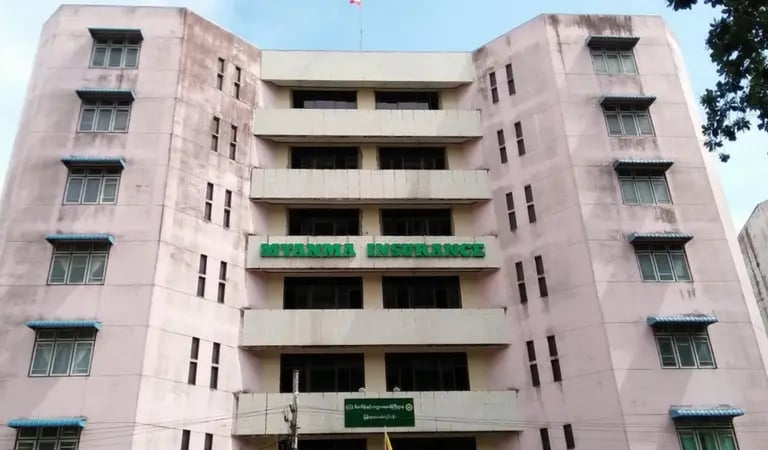
Myanmar’s insurance industry, still at an infancy stage, is beginning to see some increase in consumers’ appetite for financial security.
The change in demography and rising per capita income is expected to further stimulate the under- penetrated sector. Myanmar’s population is already hitting 53 million and young people account for about 28 percent of that figure, which is another factor.
While insurance coverage figures are still dismal, there has been an uptick in the industry as the domes-tic economy matures and industry policies are relaxed.
Since 2012, about 12 private insurance companies have begun operations, according to industry observers.
“Myanmar people don’t exactly know the advantages of insurance coverage. Insurance services entered this country later compared to other countries, so facts and knowledge about insurance should be widely disseminated. There has been a gradual increase in customers over the three years since private insurance companies started operations here,” said Than Zaw, general manager of International Kanbawza Insurance Co Ltd’s claims department.
He said insurance means providing financial compensation for a specified loss and the insurance business is a risk transfer mechanism, where a person’s risk is transferred to an insurance company by paying a certain amount of premium. “When lives, businesses or proper-ties are damaged or lost due to various reasons, money is compensated to replace these losses,” he added.
When compared to Western countries, the culture of buying insurance policies has not really caught up in Myanmar, said Than Zaw. Lack of awareness about insurance coverage and social taboos continue to hinder the industry’s growth. According to state-owned Myanma Insurance, the number of cars insured with the company and other private firms have not even reached 10 per-cent of the total number of automobiles in Myanmar.
“There are over 6000 cars insured with Myanma Insurance and over 60,000 with six other private insurance companies. There are about 800,000 automobiles registered with the Road Transport Administration Department [RTAD], meaning over 700,000 uninsured cars ply the roads compared to less than 10pc insured,” said Aye Min Thein, Myanma Insurance’s administrative director.
In some countries, there is a mandatory requirement for car insurance, but in Myanmar no such law exists yet. However, according to RTAD regulations, if a driver knocks down a person, compensation has to be paid to the victim, he said.
Experts say there should be a wider use of insurance services and some of it should be made mandatory, as in developed countries.
University lecturer Thidar Aye, who has health insurance, said, “Right now, I only have my health insurance that covers specific medical costs and not all of them. In other countries, all types of treatment can be covered by an insurance company and we do not need to worry about medical expenses. We need to expand these kinds of insurance and service in this country.”
But existing guidelines do not favor industry players as well. There are over 40 different insurance policies at Myanma Insurance, but private companies can only promote 12 types to the public, including insurance for fire, life, health, car and snakebites. As for company coverage, staff should have life insurance but only a few are insured, according to insurance experts.
“You can have insurance for all kinds of employees. It would be practical for blue-collar workers, such as those in the construction sector, to be insured. The fee is not much. By paying a premium from K1000 to K50,000, a worker injured in an accident can receive compensation of K100,000 to K5 million,” CB Insurance’s administrative director Thaung Han said.
Not many small businesses have insurance and those who do have a policy, like fire insurance, only get it to qualify for bank loans.
“Only a few are insured because Myanmar people think it’s not a good omen to be thinking about occupational hazards even before a business has started and they also don’t trust in insurance companies to pay them compensation,” Aung Thein, a small business entrepreneur, said.
“Our family has automobile and health insurance. We would also want to have other insurance if they are suitable for us. Once we have them, we don’t need to worry as much if any accident happens.”
First National Insurance (FNI) deputy managing director Aung Ko Ko Tin Win said insurance is a necessity. “In Myanmar’s developing economy, together with the progress of the banking sector, it is very important to protect public businesses and properties.”
He said by buying insurance policies, owners are buying protection against damages and losses that could occur.
Than Zaw concurs. “When foreign investors come here, they insure all their businesses. The premium fee is very small. If something of a large value is lost, the compensation would be huge, and so it’s indeed beneficial to the insurer. The premium fee would be only 1pc of the real value and it would not be a burden to customers.”
The FNI, under the Ministry of Planning and Finance’s Insurance Business Supervisory Board, is providing insurance services for risk management. It is also trying to create greater public awareness on the need for insurance. FNI’s head office is in Yangon and it has branches in Mandalay, Mawlamyine, Monywa and Pyay.
Managing director Myo Min Thu of Ayeyar Myanmar Insurance (AMI) said the company will adopt the latest technologies to improve its services and build customers’ confidence. AMI is planning to link up with a Sri Lankan company in the coming fiscal year to initiate an IT-based system.
To position itself more strongly in the market, the company is hiring experienced staff and younger employees, who are then given local and international trainings to enhance their talents.
Besides promoting public awareness on the importance of insurance, in major cities nation-wide AMI actively participates in natural disaster relief and rehabilitation works, said Myo Min Thu.
Insurance is seen as a sunrise industry, but there are hurdles to overcome –and public awareness is just one of them