
Farmland ripe for developments
Published on 4 June 2015 at Myanmar Times Newspaper Written by Tin (Rubynar) Yadanar Tun
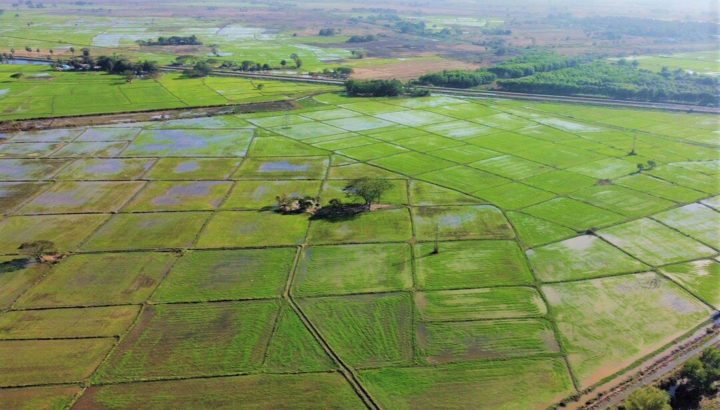
URBAN city development and planning experts have warned that unless farmland in and around Yangon is protected by law it will continue to be sold for large industrial or residential projects or divided up to be used for houses and factories.
"We need to protect the farmland. There are only a few farms left in Yangon, and many have been sold already. Under the current law it is very easy to reclassify land that is legally farmland to become another type of land. If a law to prevent this is not enacted, agricultural land in Yangon will disappear," said U Than Moe, senior adviser to the Urban Research and Development Institute.
According to the 2012 Farmland Law, it is easy to buy farmland and reclassify it for building purposes. "The related government departments need to examine this problem," said U Than Moe. The Farmland Law enacted in March 2012 aims at establishing a land use certificate and registration system.
"The agricultural land in Yangon is obviously decreasing. The rice production rate has fallen over the past four years. Farmland is rare, and there is less produce, which means prices are rising. That is not good for the future," said rice merchant U Kyaw Aye.
The price of agricultural products in Yangon region looks likely to rise if farmland continues to be used for other purposes. "Farmers are selling their land because their businesses are not doing well, and also the government is confiscating farmland. The current law does not effectively prevent the confiscation of land. We need new laws that provide greater protection," said U Kyaw Aye.
In the past, farmland has been taken to be used for Yangon's industrial zones. In addition, a plan drafted by the Japan International Cooperation Agency (JICA) in collaboration with Yangon City Development Committee (YCDC) to expand Yangon's urban area may see more farmland in Thanlyin, Kyauktan, Hmawbi, Hlegu and Htantabin townships converted to another type of land.
There are many other areas in Yangon that are still predominantly farmland including Thaketa, Dala, Kyeemyindaing, Mingalardon, Hlaing Tharyar, Thanlyin and the four Dagon townships.
On the other hand, some experts believe that low-cost and affordable high-rise buildings should be built on Yangon's outskirts where large plots of land, often classified as farmland, are available. This will help to solve the city's housing problems as its population grows.
"If we build high-rises downtown, the heritage sites and colonial buildings will be affected, so we need to build these uptown instead, where there is a lot of land at a fair price," said Daw Hlaing Maw Oo, assistant director of DHSHD's Urban and Regional Planning Division.
According to research by the World Bank, in 2012, 19.3 percent of land across Myanmar was classified as farmland, though there are no statistics available for Yangon.
Agriculture is a key sector of Myanmar's economy. The agricultural sector, including livestock and fisheries, represents 32.8pc of gross domestic product (GDP) according to the Ministry of Agriculture and Irrigation, with industry accounting for 21.0pc and services 46.2pc.
‘The agricultural land in Yangon is obviously decreasing.’ U Kyaw Aye Rice merchant
"A significant proportion of industry is also related directly or indirectly to agriculture. In fiscal year 2014, agriculture accounted for 31.8pc of export value. In terms of employment, around 61.2pc of the labour force is engaged in agriculture or depends, to a significant extent, on it for its income," according to a Ministry of Agriculture statement at the end of last year.
However, in 2001 the agriculture sector accounted for around 57pc of GDP, which had fallen to 36pc by 2010, according to figures from the Asian Development Bank (ADB).
One of biggest farms at the capital city Yangon